How to Live on Earth
Our featured film, free on YouTube. A 96-minute documentary about people building a good future by working with nature.
Watch the film ↓A Halloween story of loss, protection, and the possibility of renewal.
NotDeadYet.Earth
Thank you for visiting
Not Dead Yet was on view at 59 Geana Ln in Lowell from October 23 to November 1, 2026. Thank you to everyone who came by.
The installation has closed, but the story keeps going. Here’s what to do next.
Video
Christina Cervantes introduces Not Dead Yet and the story behind it.
Video: LMTLSS Media · Watch on YouTube ↗
The giant skeletons are ancient guardians of the land. As you walk past, they come back to life.
Act I
“We thought we had more time.”
A giant skeleton is half-buried, reaching up out of the earth among dead branches, stumps, and dry grass. Skeleton animals haunt the ground around it.
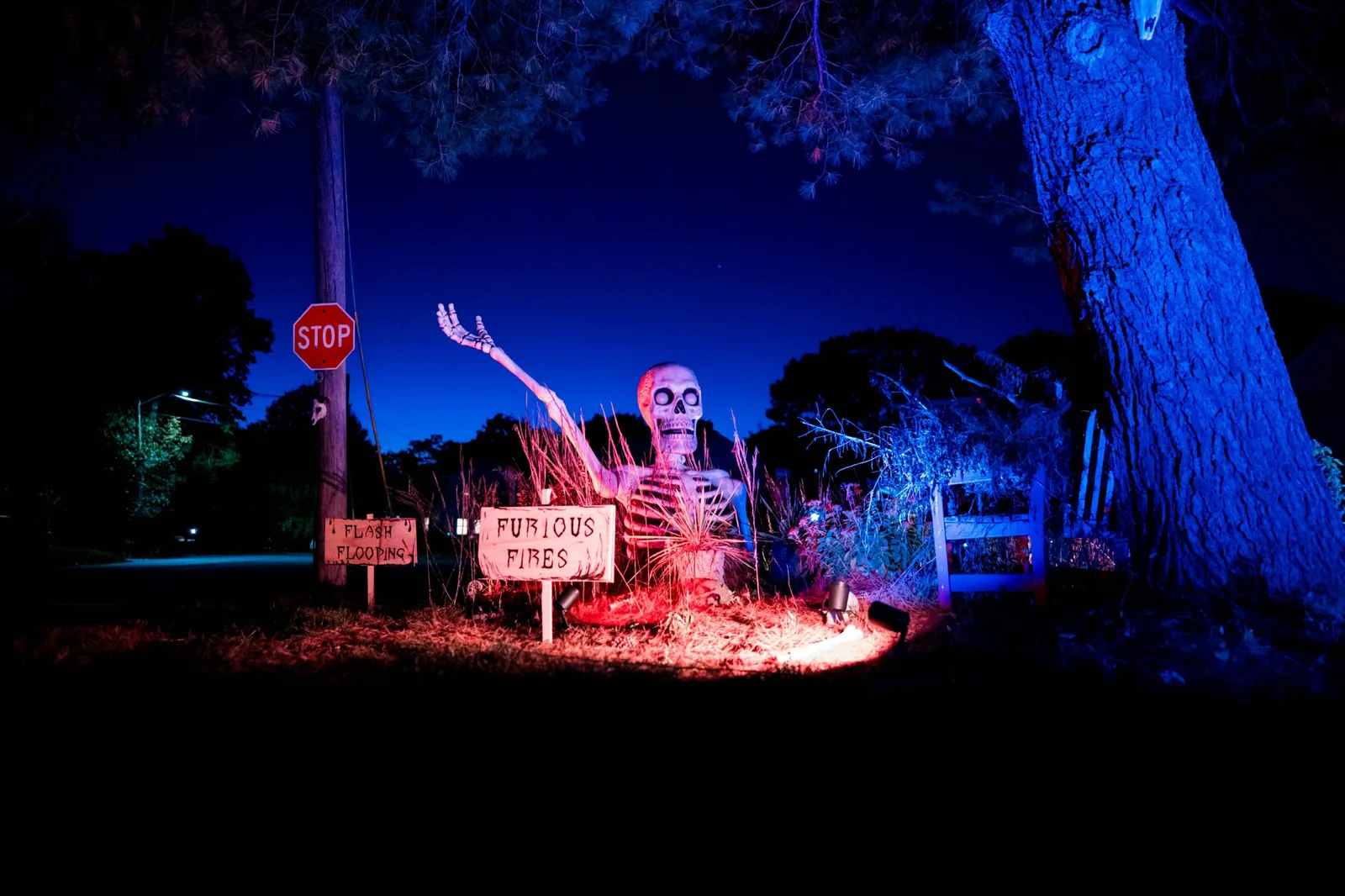
2024 was the warmest year in the global temperature record. Source: World Meteorological Organization.
Grief about the planet is real, and you don’t have to carry it alone. Here are two places to talk it through with other people.
Small peer-led groups that work through a 10-step program for climate anxiety and grief, one step a week. There’s also a program for teens.
Open ↗Hosts a weekly drop-in Climate Grief Support Group on Zoom, along with Earth-centered gatherings and resources rooted in Unitarian Universalist values.
Open ↗Act II
“Some things are worth holding onto.”
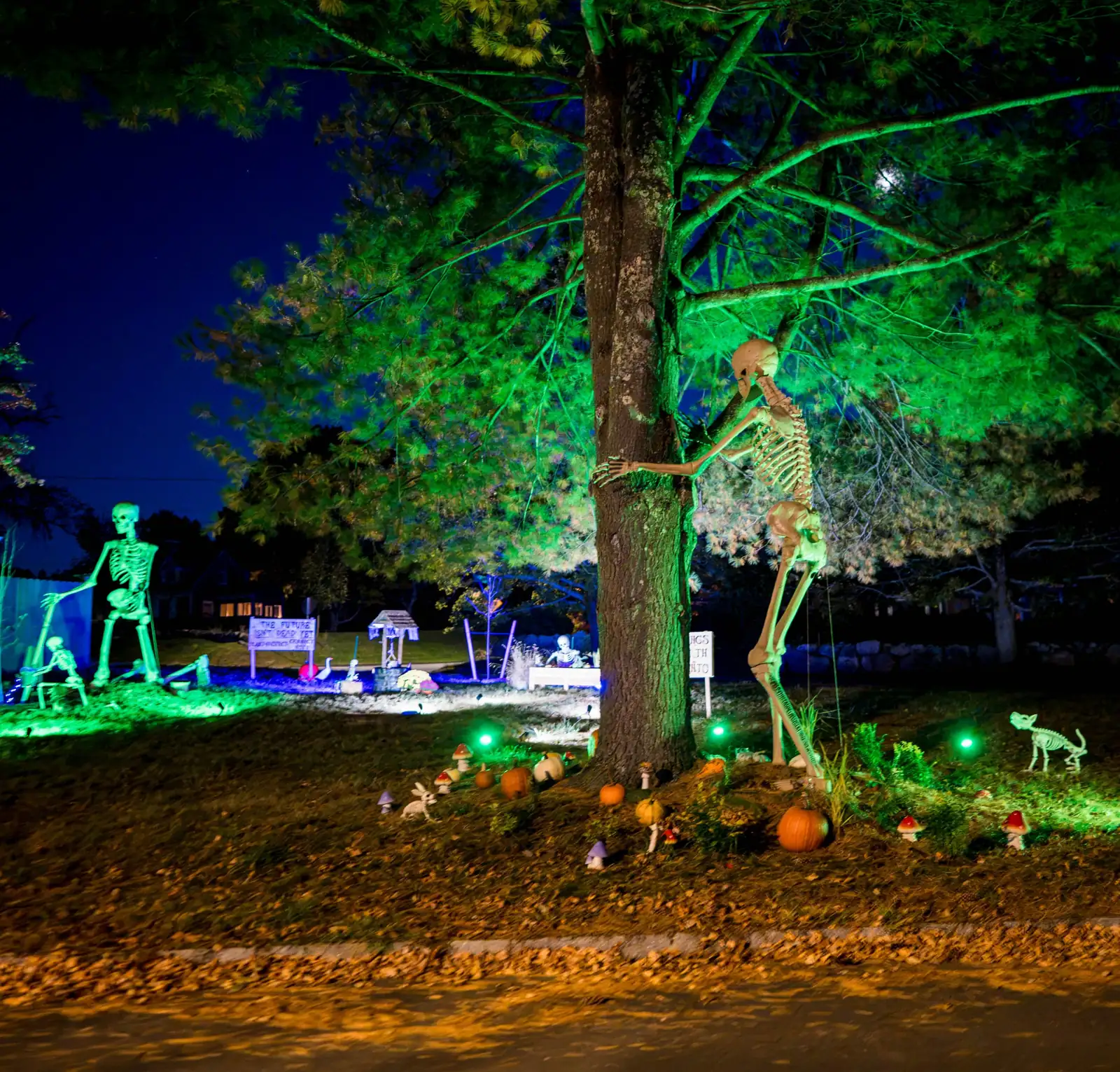
A giant skeleton stands and wraps its arms around a living pine, lit from below. At its feet the dead ground gives way to pumpkins, native grasses, and mushrooms. A German Shepherd skeleton dog looks on, urging protection.
Act III
“The future isn’t dead yet.”
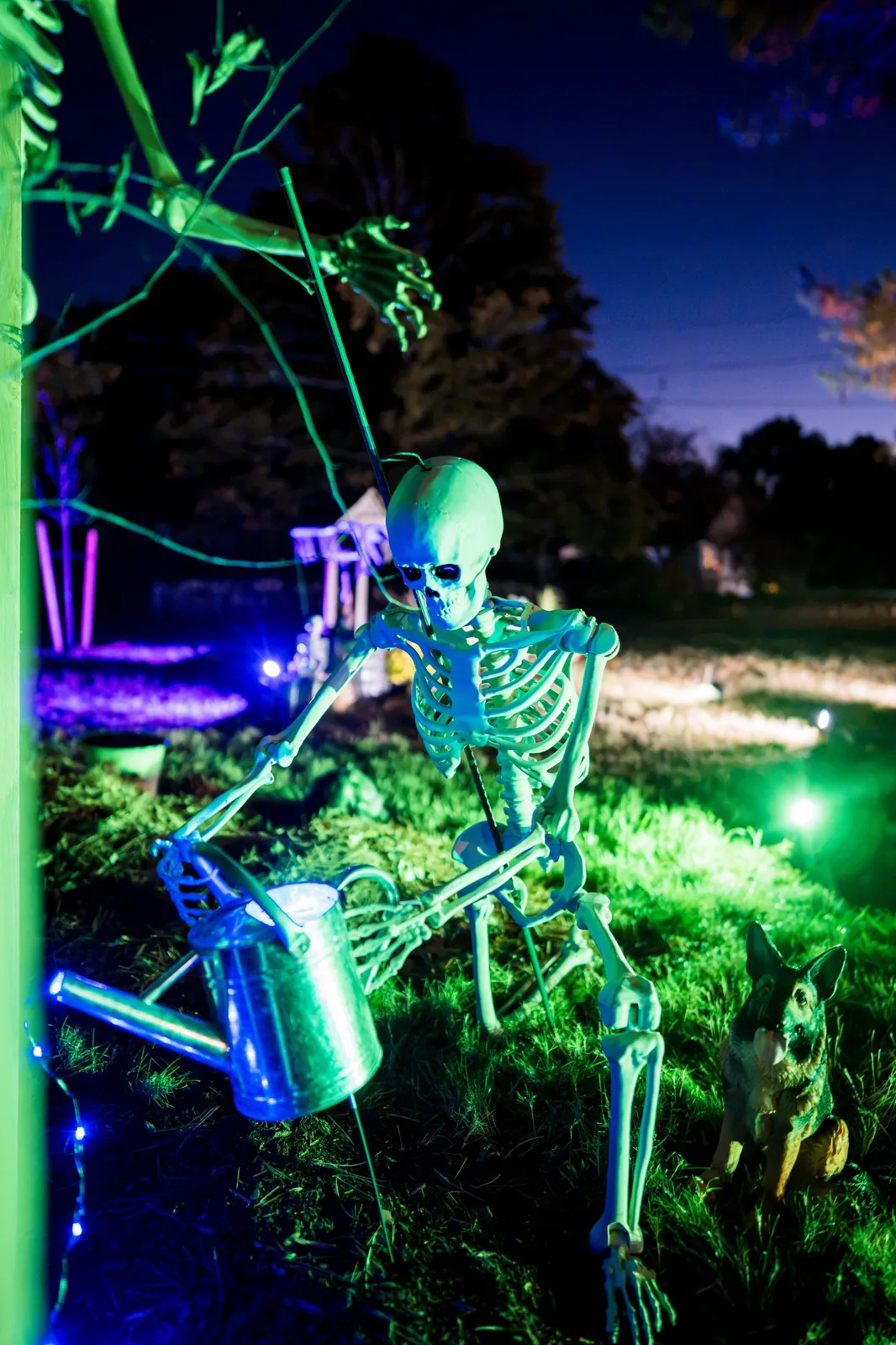
A giant skeleton kneels beside a small one watering a sapling. Native grasses grow back, and the woodland animals return. Small skeletons get to work: planting trees, tending the water, picking up trash, riding bicycles, harvesting a garden. On a bench, a mother skeleton holds her little one.
Nothing about the ending is decided yet. What happens next depends on what we do.
Scan to bring it back to life
Pick a path. Each one has a few things you can start this week. No sign-up, no account.
Native plants feed the insects that feed the birds. One plant in the right place is a small restored habitat.
Plant something native: swap one plant in your yard, or one pot on your steps, for a Massachusetts native.
Look up which plants are native here, and identify the ones you already have.
Leave the leaves this fall. Let fallen leaves stay in garden beds as winter shelter for insects.
Plant a shade tree to cool your street and give wildlife a home.
Lowell sits where the Concord meets the Merrimack. Caring for the places we love here is part of the same work as protecting forests and wildlife everywhere.
Join the weekly Stewardship Crew, or become a land steward and help care for a local green space.
Learn what the Merrimack River needs and how to help it.
Visit a wildlife sanctuary this season and bring someone who has never been.
Learn about native forest restoration projects and ways to support them.
Support protection of threatened tropical forests and the species that live there.
Resilient places are made of neighbors who know each other. Start with a garden, a cleanup, or a knock on a door.
Help a neighbor prepare for emergencies: storms, power outages, flooding, or a heat wave.
Get to know three neighbors and swap emergency contact information.
Join a community garden, volunteer, or support local food access.
Join a cleanup, or adopt a street near you and keep it clean.
Volunteer with a local organization.
Most of a household’s footprint comes from heating, driving, and buying. Small switches add up.
Book a no-cost home energy assessment.
Explore household electrification: heat pumps, induction stoves, and other electric upgrades.
Make one trip a week by bus, bike, or on foot.
Before you buy something new, try to fix it, borrow it, or buy it used.
See which climate solutions have the biggest impact.
Decisions about land, water, and energy are made by people we elect. Being registered and informed is the first step.
Make sure you’re registered, and update your address if you’ve moved.
Research environmental issues before voting, using a checklist for every level of government.
Compare candidates and ballot questions with a nonpartisan guide.
Next election, bring a friend who has never voted.
Write to your state legislators about one environmental issue you care about.
Level 1 · Lowell, Chelmsford & the Merrimack Valley
Find your people. Help your neighbors. Build resilience right here in Greater Lowell.
Climate resilience is more than cutting emissions. It means knowing your neighbors, having good food nearby, protecting green spaces, and making sure no one is left behind when a storm or heat wave hits.
These are recommended resources. Listing an organization here does not mean it is a sponsor or partner of the installation.
Land conservation, urban forestry, wildlife protection, and environmental education in Lowell, including the Concord River Greenway.
Try this: Volunteer for their weekly Stewardship Crew, or become a land steward.
Visit website ↗Community gardens, fresh-food access, food justice, and sustainable urban agriculture in Lowell.
Try this: Join a community garden, volunteer, or support local food access.
Visit website ↗Collects food and delivers it to pantries, shelters, and schools across the Merrimack Valley, and rescues food that would otherwise go to waste.
Try this: Make a donation to help feed neighbors across the Merrimack Valley.
Visit website ↗A Dracut family farm growing vegetables and fruit, with a CSA, farm stands in Dracut and Tewksbury, stands at local farmers markets including Lowell’s, and seasonal pick-your-own.
Try this: Sign up for a CSA share, or go pick your own pumpkins, apples, or berries in season.
Visit website ↗A family dairy farm in Dracut since 1908, bottling its own milk, much of it in reusable glass bottles, and making ice cream from its own cows’ milk.
Try this: Get milk delivered in returnable glass bottles, or stop by the farm for a scoop of ice cream.
Visit website ↗Volunteer-run community cleanups, neighborhood improvements, rewilding, and winter help for neighbors.
Try this: Join a cleanup or adopt a street.
Visit website ↗Works to protect and restore the Merrimack River and the land and water that drain into it.
Try this: Read up on the river’s health and sign up to hear about volunteer opportunities.
Visit website ↗Habitat protection, family nature programs, and conservation volunteering across Massachusetts.
Try this: Take the family to a nature program at a wildlife sanctuary.
Visit website ↗Native plant education and ecological gardening, home of Garden in the Woods and the Go Botany identification tool.
Try this: Use Go Botany to identify a plant in your neighborhood.
Visit website ↗Practical native landscaping and biodiversity, with free talks, guides, and plant lists.
Try this: Attend one of their free public talks on native plants.
Visit website ↗Housing stability, economic resilience, and support for vulnerable neighbors across the Merrimack Valley.
Try this: Share their services with a neighbor who needs help, or ask how to volunteer.
Visit website ↗Connects the university’s climate and sustainability work with the wider community.
Try this: See what the university is doing on climate and look for public events.
Visit website ↗Level 2
Take practical climate action, support restoration, and help protect the natural world.
Protecting the ecosystems we still have, restoring damaged land, and cutting fossil-fuel pollution all work together, and each one needs the others.
Shared for learning. Inclusion is not an endorsement, and these organizations have not endorsed this project.
Cofounded by Doug Tallamy and Michelle Alfandari, it asks everyone to replace part of their lawn with native plants, turning yards and gardens into one nationwide park for wildlife.
Action: Plant natives, then add your yard to the Homegrown National Park map.
Open ↗Helps restoration teams around the world grow native forests, with a focus on native biodiversity, seed collection, and long-term forest stewardship.
Action: Learn about forest restoration projects and ways to support them.
Disclosure: Christina Cervantes, the artist behind Not Dead Yet, is a former Terraformation employee.
Open ↗Partners with local organizations to create protected areas for threatened tropical forests and species.
Action: Support protection of threatened tropical habitats.
Open ↗A global conservation organization working to protect land and water in the U.S. and around the world.
Action: Explore land, freshwater, and marine conservation.
Open ↗Supports research and projects that address climate and nature together, organized around the world’s bioregions.
Action: Learn about climate solutions and restoration where you live.
Open ↗Founded in 2000 by siblings Philippe and Alexandra Cousteau, it helps young people take action to protect and restore the ocean and the world’s water.
Action: Order a Water Challenge kit and test the water quality of a local river or pond.
Open ↗Assesses which climate solutions work best and helps people and organizations put them into action.
Action: Understand evidence-based climate solutions.
Open ↗Helps households and communities switch to efficient electric heating, cooking, and transportation.
Action: Explore household electrification and energy upgrades.
Open ↗An international climate movement working to keep fossil fuels in the ground and build clean, community-led renewable energy.
Action: Sign up for updates and join one of their campaigns.
Open ↗A climate-focused media and action platform for following developments and joining public discussion.
Action: Follow climate developments and engage with campaigns.
Open ↗A nonpartisan, volunteer-led group that trains people to talk with their elected officials about climate policy.
Action: Take part in organized climate-policy advocacy.
Open ↗Level 3 · Nonpartisan
Vote for a livable planet. Learn how local, state, and national decisions affect the environment, and vote with that knowledge.
What are the people asking for your vote actually going to do about the future of our planet?
This site does not endorse any party or candidate. Each resource below is labeled so you know who is behind it: official government sources, nonpartisan research, or advocacy groups with a point of view.
Local elections in Massachusetts run on their own schedule, so check your city or town clerk’s website for upcoming dates.
Register, check your status, and update your address if you’ve moved. Before each election, request a mail ballot and find your polling place here.
Open ↗From the League of Women Voters Education Fund. Before each election, enter your address to compare candidates and ballot questions.
Open ↗Voting information for visitors from outside Massachusetts.
Open ↗Ask the same questions of candidates at every level of government.
Tree canopy, flood protection, stormwater, land conservation, zoning, walking and biking routes, emergency preparedness
Clean electricity, energy affordability, public transit, wetlands protection, climate resilience funding, building efficiency
Climate legislation, energy policy, federal conservation funding, environmental enforcement, clean-energy research
Environmental agency leadership, regulatory priorities, international climate agreements, federal land management
Free tools to look up your state legislators, see how they vote, and follow environmental bills between elections. Now run by Plural Policy.
Open ↗The Environmental League of Massachusetts Action Fund endorses state candidates each election, from an environmental advocacy point of view. It sends questionnaires to candidates of every party.
Open ↗Finds people who care deeply about the environment but rarely vote, and helps them vote in every election. It does not endorse candidates or take policy positions.
Open ↗The Library of Congress record of federal bills and legislative activity.
Open ↗Who funds campaigns, at the federal and state level. It merged with FollowTheMoney.org in 2021.
Open ↗Rates members of Congress on votes LCV considers important for the environment.
Open ↗Learn more
Films about forests, food, fungi, and the future, for every age.
Featured film
Presented by Benedict Cumberbatch and directed by Fredi Devas. Scientists, farmers, communities, and innovators show how people can build a good future by working with nature.
A father imagines the world in 2040 if the climate solutions we already have were widely used.
A couple turns worn-out farmland into a thriving, diverse ecosystem. Beautiful and easy to love.
Industrial agriculture, soil health, and farmers using regenerative practices.
Some of its claims about regenerative farming are debated, which makes for a good discussion.
Soil regeneration, food systems, and storing carbon through farming.
Its claims about soil carbon are ambitious. Cutting emissions still matters.
An Indigenous Uru-eu-wau-wau community defends its Amazon territory against deforestation. Intense and sometimes disturbing.
Conservationists Kristine and Doug Tompkins and the protected landscapes they helped create in Chile and Argentina.
Stunning time-lapse of mushrooms and underground fungal networks. A magical Halloween choice.
Some of its medicinal claims deserve scrutiny.
A portrait of the activist and her work for seed sovereignty and ecological agriculture.
A Massachusetts forester and his low-impact way of caring for woodland.
An investigation into how governments and investors compete to control food and water.
Dark satire: scientists try to warn humanity while media and politics look away. A pointed companion to “We thought we had more time.”
Forest destruction, greed, restoration, and the power of one person to change things. Colorful enough for young kids, with a hopeful ending.
A trash-covered Earth and one little robot who finds a living plant. Practically the three-act installation in movie form.
Magical forests, a frightening villain made of pollution, and ecological restoration. A good Halloween pick.
Interdependence, adaptation, and caring for vulnerable creatures.
Toxic forests, ecological collapse, and a heroine looking for a way to coexist.
Dark woodland fantasy about animal survival and community courage. Some scenes may frighten younger children.
Ancient forest spirits, human industry, and environmental conflict, full of mystery and danger. Best for older teens and adults.
Mysterious forests, loss, renewal, and strange creatures. More symbolic than directly environmental.
Ratings are U.S. ratings. Check streaming availability where you watch.
📖 Prefer books? See the reading lists for adults, kids and teensGood to know
About the project
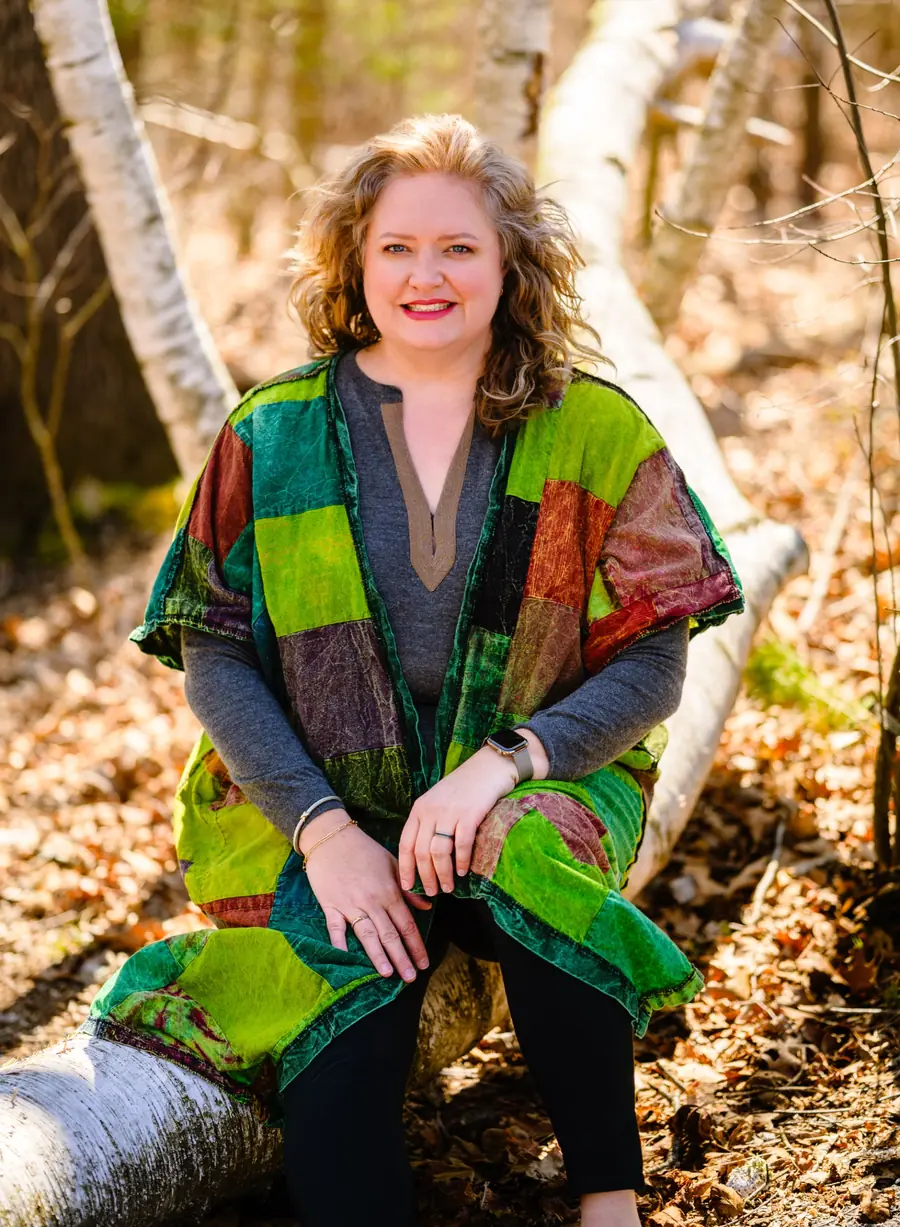
Not Dead Yet is an environmental art installation by Christina Cervantes in Lowell, Massachusetts: a Halloween story of loss, protection, and the possibility of renewal. Halloween gives us permission to be theatrical, dark, funny, and hopeful all at once. We use that to turn a spooky walk into a way toward local connection, practical action, and civic participation.
The skeletons bring people in during October, but this site is meant to stay useful all year.
I’d like to thank the following individuals, who were instrumental in bringing this vision to life:
Email info@notdeadyet.earth
This site has no ads, no cookies, and no tracking. It does not ask for your name or email. We count how many times each page is visited each day, so we know the site is useful. That count is just a number on our own site: it includes nothing about you and is not shared with anyone. If you tap “I’ll do this,” your choice is saved only in your own browser so you can find it again. Our web host may keep standard server logs. Videos come from YouTube or Instagram only if you tap play; that company’s privacy policy applies from then on.
Choose one thing to bring back to life.
No one left behind. A living planet. A future we build together.
Reading list
Twelve books for the twelve months after Halloween. Read one a month on your own, or join the Not Dead Yet book club.
The book club starts with Braiding Sweetgrass in November. Event details will be on our Facebook page.
The year moves the way the installation does: it starts with gratitude and hope, works through the hard facts, and ends back at Halloween with a warning worth heeding. Reading with kids? Jump to books for kids and teens.
November 2026
Robin Wall Kimmerer · 2013
A botanist and member of the Citizen Potawatomi Nation braids Indigenous knowledge and plant science into a book about gratitude and reciprocity with the land. A natural fit for Thanksgiving.
December 2026
Rebecca Solnit · 2004
A short, bracing case for hope as something you act on, not something you wait for. Good for the longest nights of the year. Updated edition 2016.
January 2027
Hannah Ritchie · 2024
A data scientist shows, chart by chart, where the world is actually improving and what still needs fixing. A clear-eyed way to start the year.
February 2027
Douglas W. Tallamy · 2020
How every yard can become part of a “Homegrown National Park” with native plants. Read it while you plan the spring garden.
March 2027
Richard Powers · 2018
A Pulitzer Prize–winning novel of nine people whose lives are bound up with trees. Long, but it changes how you see every tree you pass.
April 2027
Edited by Ayana Elizabeth Johnson and Katharine K. Wilkinson · 2020
Essays, poems, and calls to action from women leading on climate. Easy to read a few pieces at a time. For Earth Day month.
May 2027
Ayana Elizabeth Johnson · 2024
Conversations with people working on solutions, built around one question: what does the future look like if we succeed?
June 2027
Katharine Hayhoe · 2021
A climate scientist on how to talk about climate change with people who don’t agree with you, starting with what you share.
July 2027
Kim Stanley Robinson · 2020
A novel that opens with a deadly heat wave and follows the decades of work that come after. A big summer read.
August 2027
Suzanne Simard · 2021
A forest ecologist’s memoir of discovering how trees share resources through underground fungal networks. Pairs well with Fantastic Fungi.
September 2027
Paul Hawken · 2021
A practical guide to climate solutions you can join, from farms and forests to cities and homes. Back-to-school energy.
October 2027
Elizabeth Kolbert · 2014
A Pulitzer Prize–winning account of the species we are losing and why. The year ends where Act I begins, just in time for Halloween.
Twelve books for younger readers, from picture books to high school. Same story: what we stand to lose, what we can protect, and what we can still grow.
Ages 3–7
Barbara Cooney · 1982
A woman sets out to make the world more beautiful and does it by scattering lupine seeds. The “plant something” path as a bedtime story.
Ages 3–7
Peter Brown · 2009
A boy tends a few struggling plants on an abandoned rail line until green spreads across a gray city.
Ages 3–7
Carole Lindstrom, illustrated by Michaela Goade · 2020
An Ojibwe girl stands up to protect the water. Winner of the Caldecott Medal, and a good one to read this close to the Merrimack.
Ages 3–7
H. Joseph Hopkins · 2013
The true story of Kate Sessions, who helped turn dry San Diego into a city of trees.
Ages 8–12
Katherine Applegate · 2017
An old oak tells the story of its neighborhood, and of who belongs there. A tree worth holding onto, like Act II.
Ages 8–12
Peter Brown · 2016
A robot stranded on an island learns to survive by learning from the animals around it.
Ages 8–12
Carl Hiaasen · 2002
Middle schoolers try to stop a construction project that threatens a colony of burrowing owls. Funny, and a Newbery Honor book.
Ages 8–12
William Kamkwamba and Bryan Mealer · 2015
A teenager in Malawi builds a windmill from scrap to bring power to his village.
Ages 13–18
Robin Wall Kimmerer, adapted by Monique Gray Smith · 2022
The young adult edition of November’s pick, so a family can read it together.
Ages 13–18
Neal Shusterman and Jarrod Shusterman · 2018
When California’s taps run dry, a group of teens has to survive. Fast and tense.
Ages 13–18
Cherie Dimaline · 2017
Indigenous teens on the run in a future wrecked by climate change. Powerful, with some violence; best for older teens.
Ages 13–18
Hope Jahren · 2016
A scientist’s memoir of trees, soil, and building a life in science. Written for adults, and a good fit for teens.
Most of these are at your public library, often as e-books and audiobooks too. Lowell residents can start at the Pollard Memorial Library. Bookshop.org links support independent bookstores. This site earns nothing from any link.
Listen along
Put in your headphones and play each act’s song as you go through the story.
We thought we had more time.
Some things are worth holding onto.
The future isn’t dead yet.
Photos by LMTLSS Media.
Songs open in YouTube, which plays free in any phone browser. Spotify, Apple Music, and YouTube Music links are underneath if you prefer them.